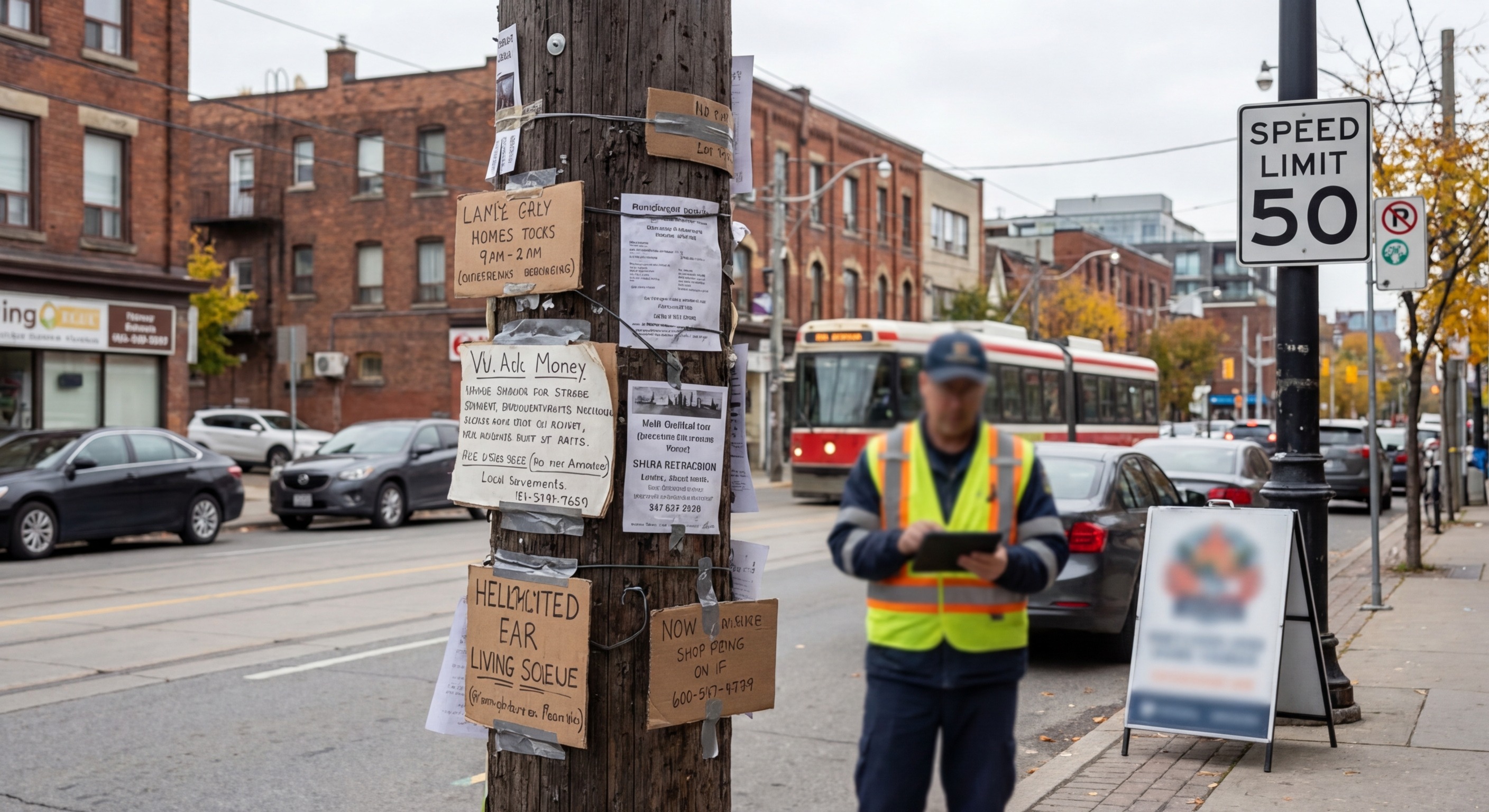
A sign is illegal in Ontario when it violates any provision of the applicable municipal sign bylaw. That sounds simple, but in practice the reasons are varied and the line between legal and illegal can be surprisingly thin. A sign that is perfectly legal on one side of a municipal boundary can be illegal three metres away. A sign that was legal when installed can become illegal when the permit expires, the business closes, or the bylaw gets amended.
The authority for all of this comes from the Municipal Act, 2001 (Section 99), which gives municipalities broad powers over signs. Here are the most common reasons signs get flagged, ordered removed, or generate fines across Ontario.
No Permit
Most permanent signs and many temporary signs in Ontario require a municipal sign permit before installation. In Toronto, this is governed by Chapter 693. In Ottawa, By-law 2016-326. In Mississauga, By-law 0054-2002. The specifics vary, but the principle is consistent: you need permission before you put up most signs.
A sign installed without a permit is illegal even if it would otherwise comply with every other provision of the bylaw. The permit process exists so the municipality can review compliance before the sign goes up and collect the applicable fees. Skipping it means the sign was never assessed.
Common exemptions from permit requirements include small window signs (typically under 0.5 square metres), standard residential real estate "For Sale" signs, and certain temporary event signs. But "exempt from permit" does not mean "exempt from the bylaw." An exempt sign still has to comply with size, placement, and other requirements.
The practical problem: many small business owners do not know they need a permit. A restaurant owner puts up a new fascia sign thinking the landlord's permission is sufficient. A hair salon installs a projecting sign without realizing the city requires an application. The first they hear about the permit requirement is when a compliance notice arrives, often triggered by a competitor's complaint.
Size Violations
Every sign bylaw sets maximum dimensions for each sign category. These are not suggestions. Typical limits include:
- Portable signs: commonly 2.4m height, 1.2m width, around 3 square metres of sign face
- Fascia signs: usually a percentage of the wall they occupy, often 20-25%
- Ground signs: varies widely, but 6 to 8 square metres per face is common in commercial zones
- A-frames: often 0.6m by 1.0m, sometimes smaller
Size violations are the easiest to document because a bylaw officer can measure the sign on site and compare it directly against the bylaw schedule. They are particularly common with billboards, where operators sometimes push dimensions beyond what is permitted, and with portable signs where businesses use the largest sign they can find at the supply store without checking local limits.
Placement in the Right-of-Way
This is the single most common unintentional sign violation in Ontario. The municipal right-of-way — the publicly owned land that includes the road, sidewalks, boulevards, and shoulders — extends further from the road than most people realize. For a typical urban arterial road, the right-of-way can extend 15 to 20 metres from the centre of the road. That grassy strip between the sidewalk and your property line? Almost certainly municipal land.
Signs placed in the right-of-way without authorization are illegal. This catches real estate agents who put directional signs on boulevard grass, businesses that place portable signs near the curb, and homeowners who put up garage sale signs on utility poles. The sign looks like it is at the edge of private property, but legally it is on municipal land.
Municipalities can generally remove signs from the right-of-way without advance notice, especially on public property like boulevards and utility poles. For more detail, see our guides on right-of-way signs and signs on public property.
Prohibited Locations
Certain locations are off-limits for signs regardless of size, type, or permit status:
- Utility poles, traffic signal poles, and street light standards — signs on these structures create safety hazards for utility workers and obstruct traffic signals
- Public parks, conservation areas, and municipal lands
- Bridge structures and overpasses
- Within the sight triangle at intersections (typically 6m along each leg, no signs above 0.75m)
- Heritage conservation districts, where additional restrictions apply
Signs in prohibited locations are subject to immediate removal in most jurisdictions. No advance notice required. The municipality can take the sign down and charge the cost of removal to the sign owner.
Expired Permits
Permits for temporary signs — portable signs, construction signs, event signs — are issued for a defined period. A portable sign permit might be valid for 30, 60, or 90 days depending on the municipality. Once the period expires, the sign must come down. A sign that remains after its permit expires is treated the same as a sign that never had a permit.
This creates a recurring problem for businesses that use portable signs. They get a permit, put up the sign, and then forget about the expiry date. Some municipalities send reminder notices, but the legal obligation to track the permit period is on the sign owner. Renewal requires a new application and fee before the original expires.
Non-Compliant Illumination
Illuminated signs are subject to specific regulations on brightness, animation, and hours of operation. The rules have become much more detailed as digital signs have proliferated. Typical requirements include:
- Maximum brightness: 5,000-7,000 nits daytime, 300-500 nits nighttime
- Automatic dimming via photocell sensor required
- Minimum dwell time for changing messages: 6-10 seconds
- No full-motion video, animation, or scrolling text (in most municipalities)
- No light spillage onto adjacent residential properties
Illumination complaints are most common in mixed-use areas where commercial signage is near residential properties. A digital sign that meets brightness standards during the day can become a violation at night if the auto-dimming system is not functioning properly. See our guide on digital signs and LED displays for more detail.
Abandoned Signs
When a business closes, its signs become "abandoned" under most bylaws. The property owner is typically required to remove abandoned signs within 60 to 90 days. In practice, this rarely happens on its own. Abandoned signs persist because nobody files a complaint, and enforcement is complaint-driven. Drive through any commercial strip in Ontario and you will see signs for businesses that closed months or years ago.
A Sign Can Become Illegal Over Time
A sign that was legal when installed can become illegal through:
- Permit expiry
- Business closure (abandoned sign)
- Bylaw amendment (new rules making the existing sign non-compliant)
- Structural deterioration (sign becomes unsafe)
- Change in surrounding conditions (new development changes the sight triangle)