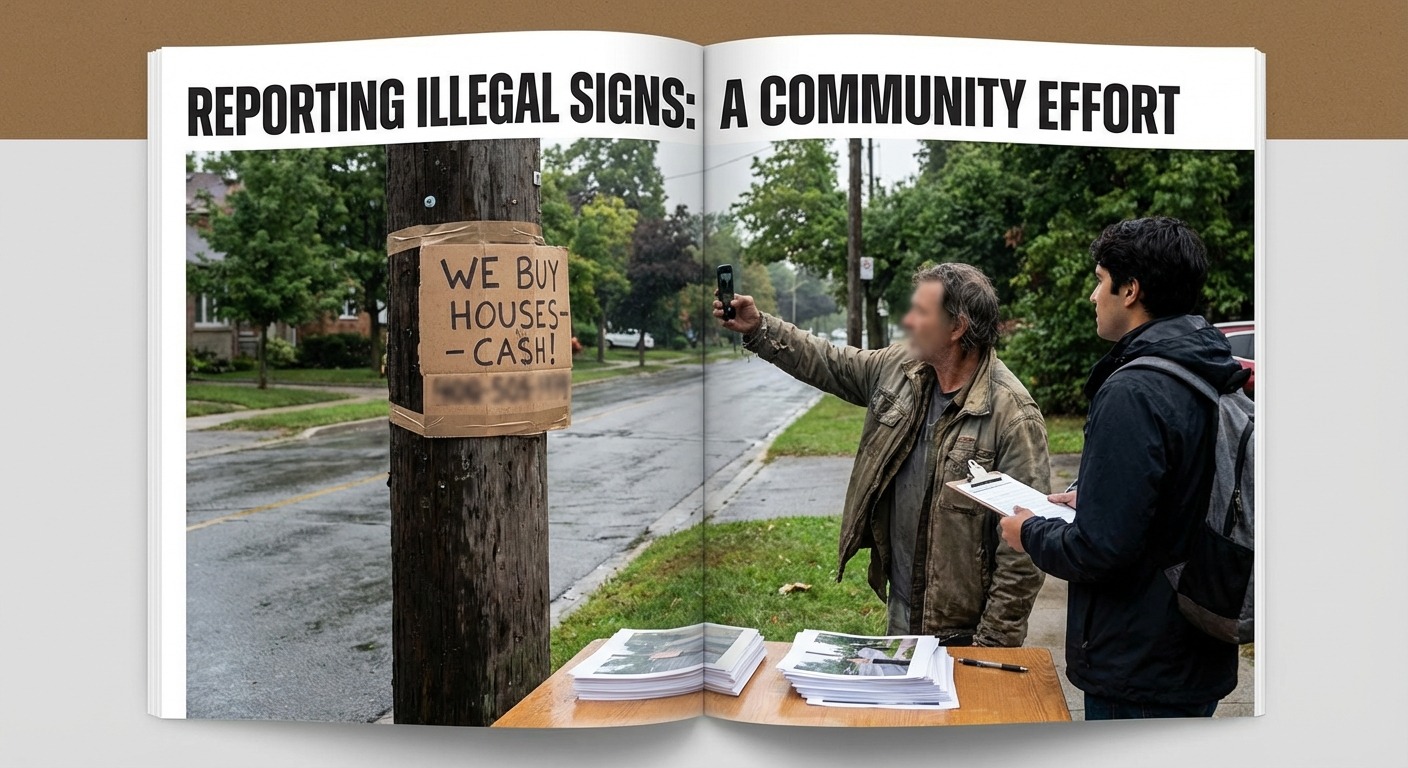
Most people who report illegal signs in Ontario do it because something specific frustrates them. A business competitor is flouting the rules. Bandit signs keep appearing on the utility poles in their neighbourhood. A billboard is lighting up their bedroom window. Whatever the trigger, the reporting process is straightforward — but how you report determines whether your complaint leads to action or disappears into a backlog.
Step 1: Document the Sign
Good documentation is the difference between a complaint that gets acted on quickly and one that requires multiple follow-up visits from a bylaw officer before anything happens.
Take photos. Three shots minimum:
- A close-up of the sign showing its content, text, and any contact information
- A medium shot showing the sign's placement — on a pole, on a boulevard, on a building
- A wide shot showing the sign's location relative to recognizable landmarks — street signs, intersections, building numbers
Record the location. Street address or nearest intersection. If the sign is not near a numbered address, be specific: "northwest corner of King and Main, on the utility pole adjacent to the bus stop." GPS coordinates from your phone's map app are even better — most 311 systems can accept coordinates.
Note the date and time. This matters for temporary signs that may have exceeded their permitted display period and for establishing patterns (the same sign appearing repeatedly after removal).
Identify the sign type if you can. "Bandit sign on utility pole," "oversized portable sign in the right-of-way," "billboard with no visible permit number." This helps the intake officer categorize and route your complaint. You do not need to cite the specific bylaw section — that is the officer's job — but describing the sign type helps.
For detailed documentation strategies, see our guide on documenting sign violations.
Step 2: Identify the Right Authority
Almost always, your municipality is the right contact. Sign bylaws are enacted and enforced at the municipal level under the Municipal Act, 2001.
Exception — provincial highways: Signs on 400-series highways and other provincial roads fall under MTO jurisdiction. Use the MTO online reporting form.
Exception — regional roads: In two-tier municipal systems (like Durham Region, Halton Region, Peel Region), signs on regional roads may be the regional government's responsibility rather than the lower-tier municipality's. If in doubt, start with your local municipality — they will redirect if needed.
Step 3: File Your Complaint
Channels available in most Ontario municipalities:
311 service (larger cities). Toronto, Ottawa, Hamilton, London, and other large municipalities operate 311 services by phone, web, and mobile app. This is usually the fastest and most trackable option. You get a reference number you can use to follow up. In Toronto, select "Bylaw Complaint" then "Signs - Illegal." In Ottawa, it goes through the Bylaw Services intake on ServiceOttawa. See 311 and online reporting for city-specific details.
Online complaint form. Many municipalities that lack full 311 systems have online bylaw complaint forms. Search for "[your municipality] bylaw complaint" to find it. These forms typically ask for location, description, and contact information, with an option to upload photos.
Phone. Call your municipal bylaw enforcement office. For smaller municipalities, the general municipal phone number will connect you. Ask for bylaw enforcement and describe the sign violation.
Email. Some municipalities accept complaints by email. This works well because you can attach photos and have a written record. Check your municipality's website for the bylaw enforcement email address.
Step 4: What to Include
- Exact location of the sign (address or intersection)
- Description of the sign type and what it advertises
- Why you believe it violates the bylaw (if you know — optional but helpful)
- Photos
- Date and time observed
- Whether this is a repeat issue (sign keeps reappearing after removal)
- Your name and contact information
Step 5: Follow Up
If you filed through a 311 system, use your reference number to check status online or by phone. If you filed through other channels, follow up by email or phone after a reasonable period — typically 5 to 10 business days for initial acknowledgment, 2 to 4 weeks for a response.
If the sign is still there after 30 days and you have heard nothing, follow up again. Reference your original complaint. It is possible that the officer visited and did not find a violation, that a compliance notice was issued with a deadline that has not passed, or that the complaint was deprioritized. Persistent but respectful follow-up is appropriate.
If the municipality is not acting on repeated legitimate complaints, options include contacting your municipal councillor, speaking during public comment at a council meeting, or, in extreme cases, contacting the Ontario Ombudsman.
What Not to Do
Do not remove signs yourself. Even if the sign is obviously illegal, removing someone else's property could expose you to liability. Let the municipality handle removal.
Do not confront the sign owner. File your complaint through official channels. Confrontations escalate situations that the bylaw system is designed to resolve administratively.
For what happens after your complaint is filed, see what happens after reporting.