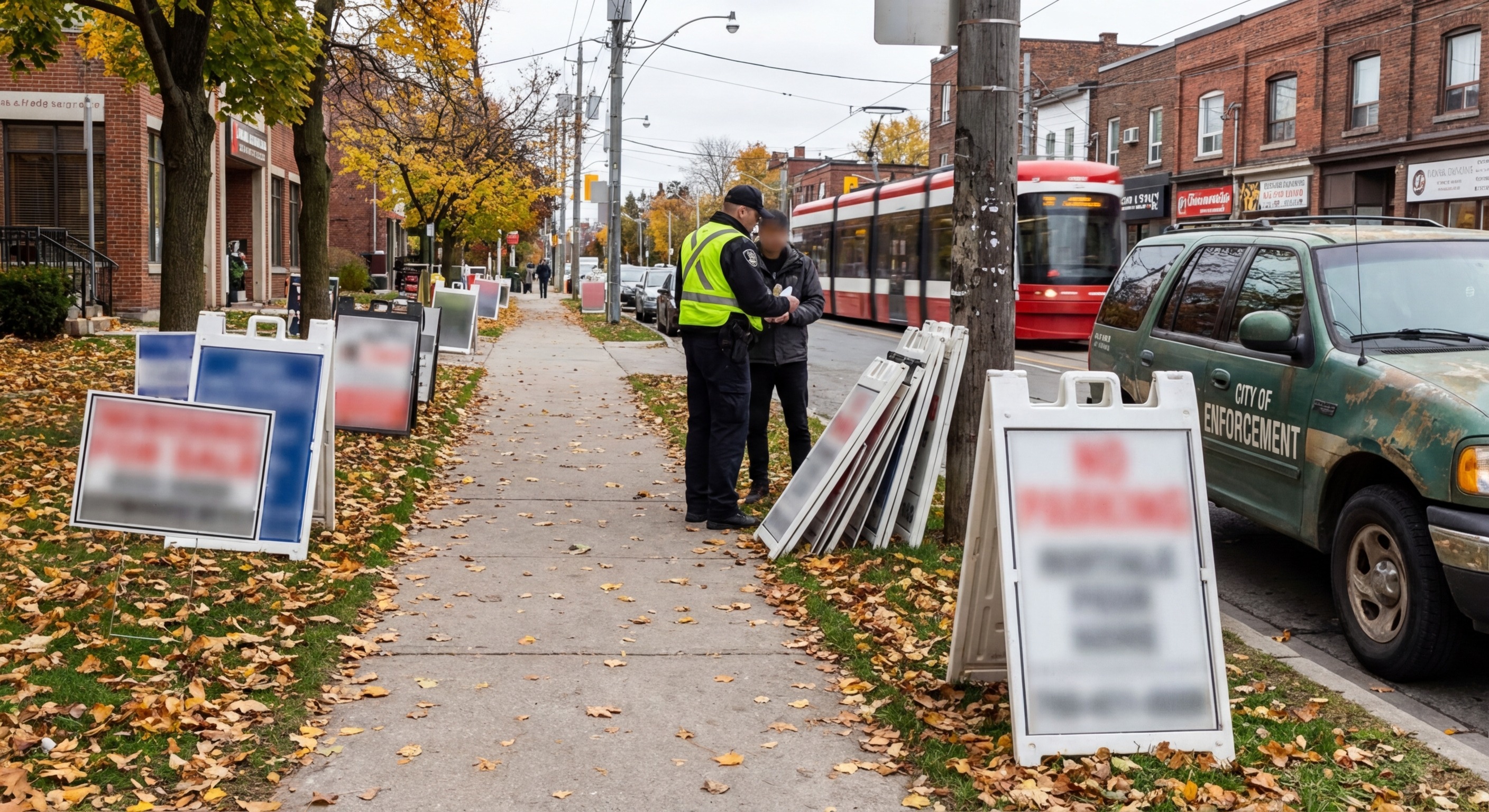
The most common unintentional sign violation in Ontario is placing a sign in the municipal right-of-way. It happens constantly because most people have no idea how far the right-of-way extends. That strip of grass between the sidewalk and the road? Municipal land. The area between the sidewalk and your front property line? Often municipal land too. The grassy boulevard you mow and treat as part of your lawn? Public property.
Signs placed on the right-of-way without municipal authorization are illegal in every Ontario municipality. And unlike signs on private property, where enforcement usually starts with a compliance notice and a deadline, signs on the right-of-way can be removed by the municipality immediately and without prior notice.
What Is the Right-of-Way?
The right-of-way (ROW) is the publicly owned land that accommodates the road and its associated infrastructure. It includes:
- The road surface (lanes, medians, shoulders)
- Sidewalks
- Boulevards (the grassy area between road and sidewalk, or between sidewalk and private property)
- Ditches and drainage swales
- Utility corridors
The width of the right-of-way varies by road classification. A typical urban residential street has a ROW of about 20 metres. An urban arterial road can have a ROW of 26 to 36 metres. A regional road or former provincial highway might have a ROW of 30+ metres. This means the boundary between public and private land can be 10 to 18 metres from the centre of the road — much further than most people expect.
How to Find the ROW Boundary
The only definitive way to know where the right-of-way ends and private property begins is to check your property's survey plan or get a survey done. But there are some practical indicators:
- Iron bars or survey monuments — If your property has been surveyed, there may be iron bars at the front corners of the lot marking the property boundary. Anything between those bars and the road is likely ROW.
- Utility pedestals and fire hydrants — These are almost always on municipal land. If your sign is near a fire hydrant or utility pedestal, it is probably in the ROW.
- The sidewalk — In many residential areas, the sidewalk runs through the ROW. The property line is at or behind the back edge of the sidewalk, not at the front edge.
- GeoWarehouse or municipal GIS — Many Ontario municipalities offer online mapping tools that show property boundaries. Toronto's interactive map, Ottawa's geoOttawa, and other municipal GIS systems can give you an approximate boundary.
Who Gets Caught
Right-of-way sign violations are remarkably democratic. They affect:
Real estate agents — Directional "Open House" signs placed on boulevard grass near intersections are almost always in the right-of-way. The same is true for "For Sale" signs placed near the curb rather than on the property itself. Many real estate professionals have been told by their brokerages to place signs "near the street for visibility" without anyone checking whether that location is public or private land.
Small businesses — Portable signs, A-frames, and sandwich boards placed near the curb to catch passing traffic. A business operating from a property that abuts a busy road has a strong incentive to put its sign as close to the road as possible. But "as close to the road as possible" usually means the right-of-way.
Home-based businesses — Signs advertising home-based businesses placed at the end of the driveway or on the boulevard. These are on public land in most cases.
Event organizers — Directional signs for garage sales, church events, community fundraisers, and other events, placed at nearby intersections. Well-intentioned but technically illegal when on the ROW.
Why Municipalities Care
It is tempting to view right-of-way sign enforcement as petty. The sign is not hurting anyone, the argument goes. But municipalities have legitimate reasons for restricting signs in the ROW:
Liability. If someone trips over a sign in the right-of-way and is injured, the municipality can be liable because the ROW is municipal property. This is not theoretical — municipalities have paid claims related to obstructions on public property, including signs.
Sight lines. Signs in the ROW near intersections can obstruct drivers' views, particularly within the sight triangle. A sign that blocks a driver's view of approaching traffic or pedestrians is a safety hazard.
Maintenance. Municipal crews need to maintain the ROW — mowing grass, clearing snow, repairing utilities, maintaining drainage. Signs in the ROW obstruct these operations. A snow plow that hits a portable sign creates both a maintenance problem and a potential liability issue.
Precedent. If the municipality allows some signs in the ROW, it becomes difficult to enforce against others. The principle of consistent enforcement requires either allowing all signs or prohibiting all signs. Municipalities choose prohibition.
What Happens to Signs in the ROW
Most bylaws authorize immediate removal of signs from the right-of-way without advance notice. The municipality takes the sign and holds it for a defined period — typically 30 days in larger municipalities, sometimes less in smaller ones. The sign owner can retrieve it by paying a retrieval fee. After the holding period, unclaimed signs are disposed of.
For a sign on private property near the ROW boundary, enforcement follows the standard process: compliance notice, deadline, escalation. The sign is on private land, so the municipality must follow the notice procedure before removing it.