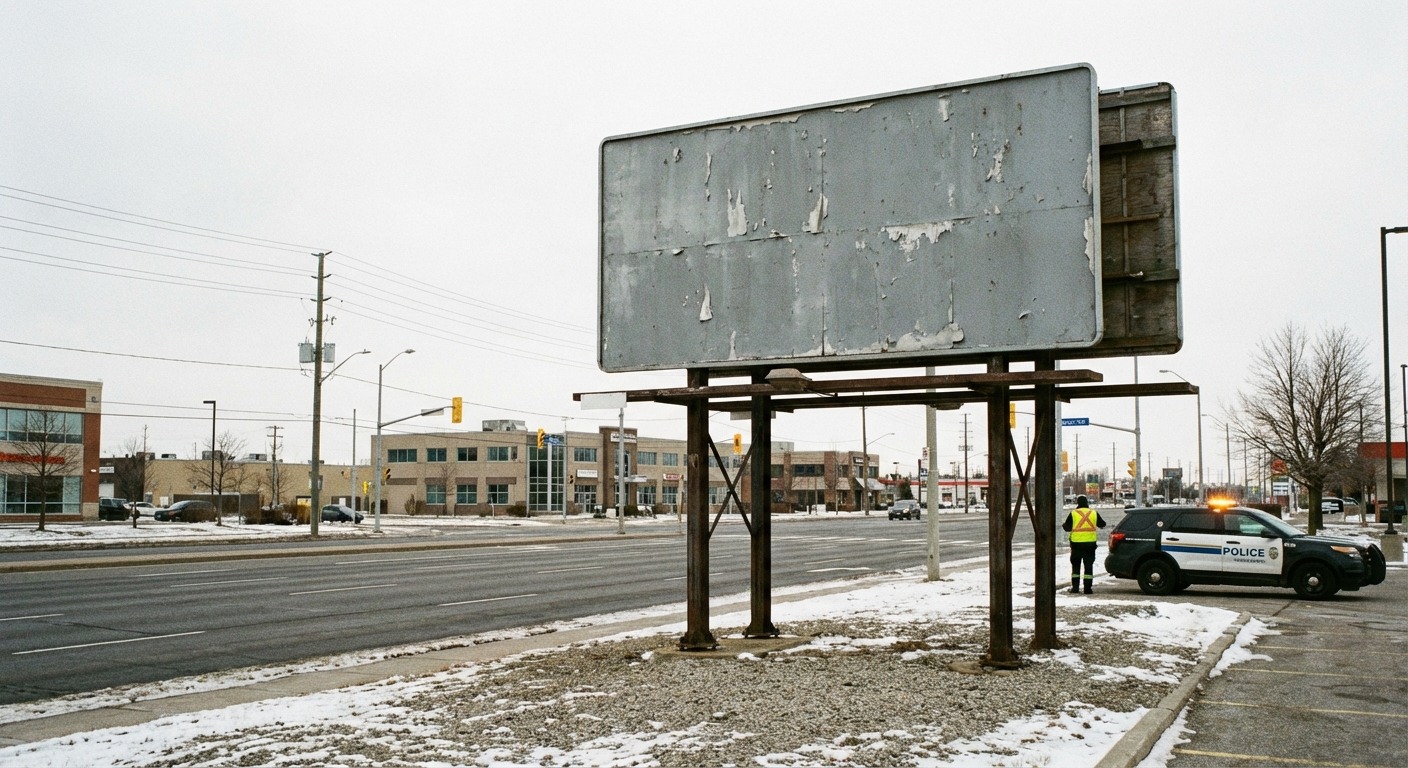
Billboards are the highest-stakes category of sign regulation in Ontario. A billboard on the 401 corridor can generate $5,000 to $15,000 per month in advertising revenue. A large digital billboard at a major urban intersection can generate even more. With that kind of money at stake, billboard operators push boundaries, municipalities struggle to keep up, and illegal billboards can remain profitable even after fines.
Billboards are technically "third-party signs" — signs that advertise a product, service, or business not located on the property where the sign stands. This distinction matters because third-party signs are more heavily regulated than first-party signs (signs advertising a business at its own location) in virtually every Ontario municipality.
How Billboards Are Regulated
Municipal billboard regulations typically address:
Location restrictions. Billboards are generally restricted to commercial and industrial zones. Many municipalities prohibit new billboards in residential areas entirely. Separation distance requirements prevent billboard clustering — a common rule is that no two billboards can be within 100 to 300 metres of each other.
Size limits. Maximum billboard dimensions vary by municipality and road classification. A billboard on a major arterial might be permitted up to 20 square metres per face. Smaller roads may have lower limits. Height is typically capped at 7.5 to 15 metres above grade.
Setbacks. Minimum distance from the road, from property lines, and from intersections. These are larger for billboards than for other sign types because of the driver distraction concern.
Permit requirements. Billboard permits are more expensive and more scrutinized than permits for other sign types. Application fees can run $500 to $2,000+, and the review process often involves planning staff, sometimes heritage review, and occasionally council approval.
Toronto: Chapter 693 and the Third Party Sign Tax
Toronto has the strictest billboard regulations of any Ontario municipality and the most aggressive enforcement history. Key features of Toronto's approach:
Chapter 693 severely restricts where new billboards can be installed. The combination of zoning restrictions, separation distances, and size limits means that opportunities for new legal billboard installations in Toronto are extremely limited. The bylaw was overhauled in 2010 specifically to address the billboard proliferation problem.
The Third Party Sign Tax, introduced by the city, charges billboard operators an annual tax on all legal third-party signs. The tax is designed both as a revenue measure and as a deterrent against billboard proliferation. Operators pay for every legal billboard, which changes the economics of maintaining a large inventory of billboard locations.
The Sign Unit within Municipal Licensing and Standards actively pursues illegal billboard installations. Toronto has taken billboard companies to court, obtained removal orders, and conducted forced removals of unauthorized structures. See our Toronto billboard enforcement case study for documented examples.
The Illegal Billboard Problem
Despite regulations, unauthorized billboards are a persistent problem across Ontario. The economics explain why:
A billboard generating $5,000 per month in revenue produces $60,000 per year. Even if the operator faces a $5,000 fine, the billboard remains profitable. Even multiple fines may not exceed the revenue the sign generates before it is eventually removed. The enforcement process — compliance notice, order, charges, court — can take months or years, during which the billboard continues to operate.
Some billboard operators have built this calculation into their business model. They install signs knowing they are unauthorized, collect revenue for as long as the sign stays up, and treat fines and eventual removal as a cost of doing business. Toronto's Auditor General has documented cases where unauthorized billboards operated for years before being addressed.
The situation is especially problematic along highway corridors (Gardiner Expressway, DVP, 401 through Toronto) where the audience is massive and the revenue per sign is highest. Community groups along these corridors have been vocal about the visual impact and have pushed for stronger enforcement.
The Major Players
Ontario's outdoor advertising market is dominated by a few large companies:
- Outfront Media (formerly CBS Outdoor) — Operates billboards across the GTA and major Ontario highways
- Pattison Outdoor Advertising — One of Canada's largest outdoor advertising companies, with a major Ontario presence
- Astral Media / Bell Media — Operates transit advertising, street furniture advertising, and some billboard inventory
These companies operate within the regulatory system, maintaining permitted billboards and applying for new installations through proper channels. However, disputes between these companies and municipalities about the scope of their existing permits, the legality of conversions from static to digital, and the interpretation of grandfathering provisions are common.
Below these major players are smaller operators and independent property owners who install billboards without going through the permit process. These unauthorized installations are the primary enforcement targets.
Digital Billboard Conversion
The conversion of static billboards to digital (LED) displays is one of the most contentious issues in Ontario outdoor advertising. A digital billboard can rotate multiple advertisers on a single structure, dramatically increasing revenue per location. Operators want to convert their existing static billboards to digital. Municipalities want to control the proliferation of bright, attention-grabbing digital displays.
Most municipalities treat the conversion from static to digital as a new installation requiring a new permit, not an upgrade to an existing one. This means the converted sign must meet current bylaw standards, which may be stricter than the standards that applied when the static billboard was originally installed. Many proposed conversions are denied for this reason.
For more on digital sign regulations, see digital signs and LED displays. For the broader debate about digital billboards, see our case study on digital billboard debates.