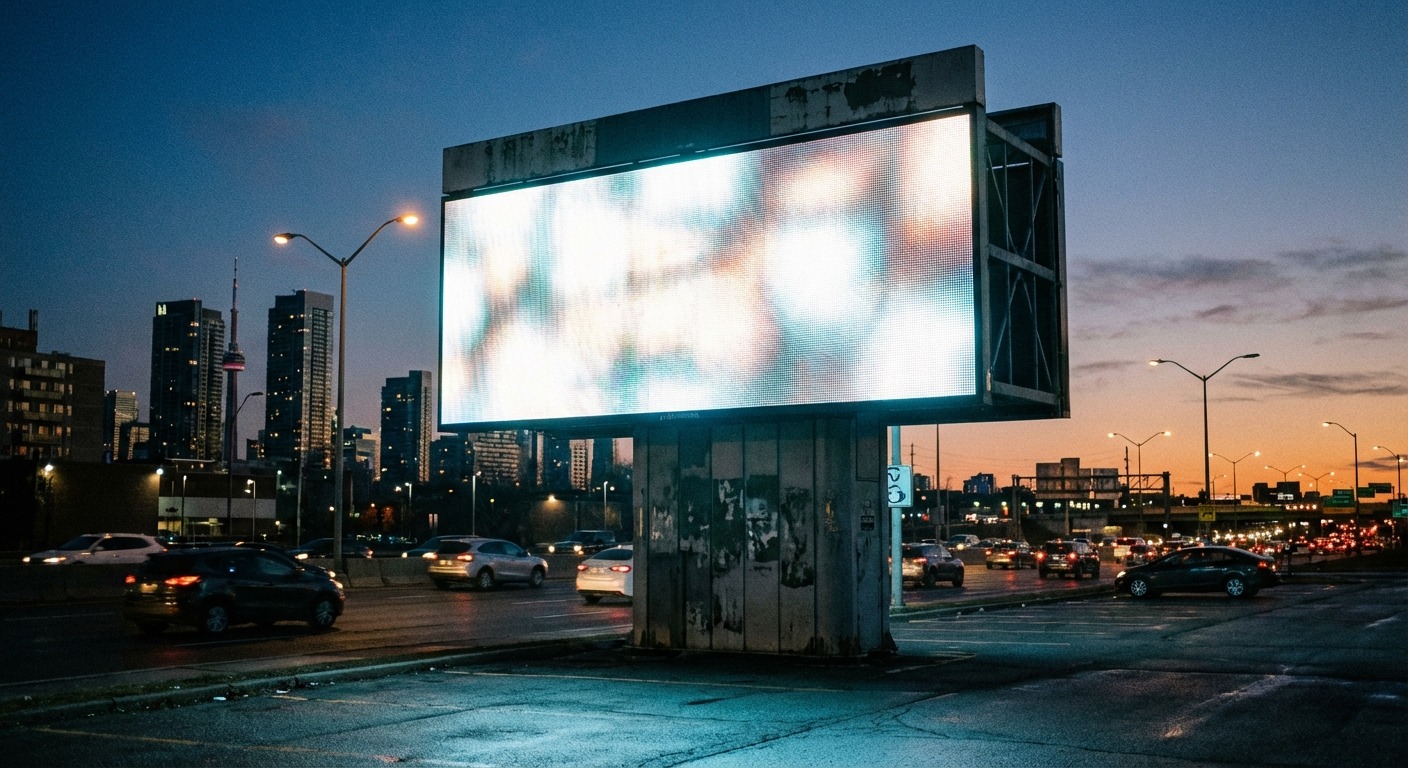
Digital billboards are the current frontier of sign regulation conflict in Ontario. The technology changed faster than the bylaws, and municipalities are now playing catch-up — writing rules for signs that did not exist when most sign bylaws were drafted. The debates playing out in council chambers across the province involve outdoor advertising revenue, driver safety research, residential quality of life, and fundamental questions about what a municipal streetscape should look like.
The Technology Shift
LED display technology has dropped in cost dramatically over the past decade. A full-colour LED billboard that would have cost $200,000 in 2010 can now be installed for $50,000 to $100,000. This has made digital conversion economically attractive for billboard operators at an accelerating rate.
The revenue difference is substantial. A static billboard at a given location might generate $3,000 to $5,000 per month from a single advertiser. A digital billboard at the same location can rotate six to eight advertisers, each paying $2,000 to $4,000, generating $12,000 to $30,000 per month from the same physical structure. This three-to-five-fold revenue increase is the driving force behind the push for digital conversion.
What Residents Say
Residents near digital billboards consistently raise the same complaints:
Brightness. The most common complaint. Digital billboards at full power are visible from hundreds of metres away. At night, even with auto-dimming engaged, the light output is significantly higher than the surrounding environment. Residents describe being able to read by the light of a nearby digital billboard, and light trespass into bedrooms is a frequent complaint.
The changing content draws attention. A static billboard fades into the background after you have driven past it a few times. A digital billboard that changes every 6 to 10 seconds demands repeated attention. Residents in adjacent properties report that the changing images are a constant visual distraction, especially at night.
Neighbourhood character. A digital billboard changes the visual character of an area. In older, lower-density neighbourhoods, the bright, commercial character of a digital display feels out of place. Heritage district advocates are particularly vocal about the incompatibility of digital billboards with heritage conservation objectives.
What the Industry Says
Outdoor advertising companies counter with their own arguments:
Auto-dimming addresses brightness. Modern digital billboards include photocell sensors that automatically reduce brightness as ambient light decreases. The industry argues that properly calibrated dimming systems address nighttime brightness concerns.
The technology is safer than static. Digital billboards can display emergency alerts, Amber Alerts, and public safety messages. They can be updated remotely in seconds. The industry argues these public safety capabilities benefit communities.
Revenue supports municipal services. In some municipalities, digital billboard agreements include revenue-sharing arrangements that contribute to municipal budgets. The industry frames digital billboards as a revenue source for the communities where they operate.
The Driver Distraction Research
The safety debate centres on whether digital billboards increase crash risk. The research is genuinely mixed:
Studies using eye-tracking technology have found that digital billboards attract longer glances from drivers than static billboards, particularly when the content changes while the driver is looking. The Swedish National Road and Transport Research Institute's research found measurable increases in driver fixation time near digital displays.
Studies funded by the outdoor advertising industry, including research conducted by the Foundation for Outdoor Advertising Research and Education (FOARE), have generally concluded that digital billboards do not cause a statistically significant increase in crash rates.
The problem with the research is that both sides can point to studies supporting their position. The honest assessment is that digital billboards probably attract more driver attention than static billboards, but whether that additional attention translates into actual crashes is difficult to prove definitively with existing data.
Municipal Responses
Ontario municipalities have responded to digital billboards in various ways:
Toronto: Cautious approach. Strict brightness limits, long dwell times, and significant restrictions on where new digital third-party signs can be installed. The city has treated static-to-digital conversions as new installations requiring new permits under current standards, effectively blocking many proposed conversions.
Ottawa: Has allowed some digital signs but with detailed technical standards. The 6-second minimum dwell time is one of the shorter in the province. Recent council discussions have focused on whether additional restrictions are needed, particularly near residential areas.
Smaller municipalities: Some have embraced digital signs as a way to modernize their commercial corridors. Others have imposed moratoriums on digital sign applications until they can develop appropriate regulations. The smaller the municipality, the less likely it is to have technical standards (brightness measured in nits, photometric testing requirements) in its bylaw.
The Conversion Battleground
The most contentious specific issue is the conversion of existing static billboards to digital. Operators argue that their existing permits should cover a technology upgrade. Municipalities argue that a digital billboard is fundamentally different from a static one — it is brighter, it changes content, and its impact on the surroundings is qualitatively different. Most Ontario municipalities have sided with the latter position, requiring new permits for conversions.
This has led to legal challenges. Billboard operators have taken municipalities to the Ontario Land Tribunal (formerly the Ontario Municipal Board) over conversion denials. The results have been mixed, but the general trend supports municipal authority to require new permits and apply current standards to proposed conversions.