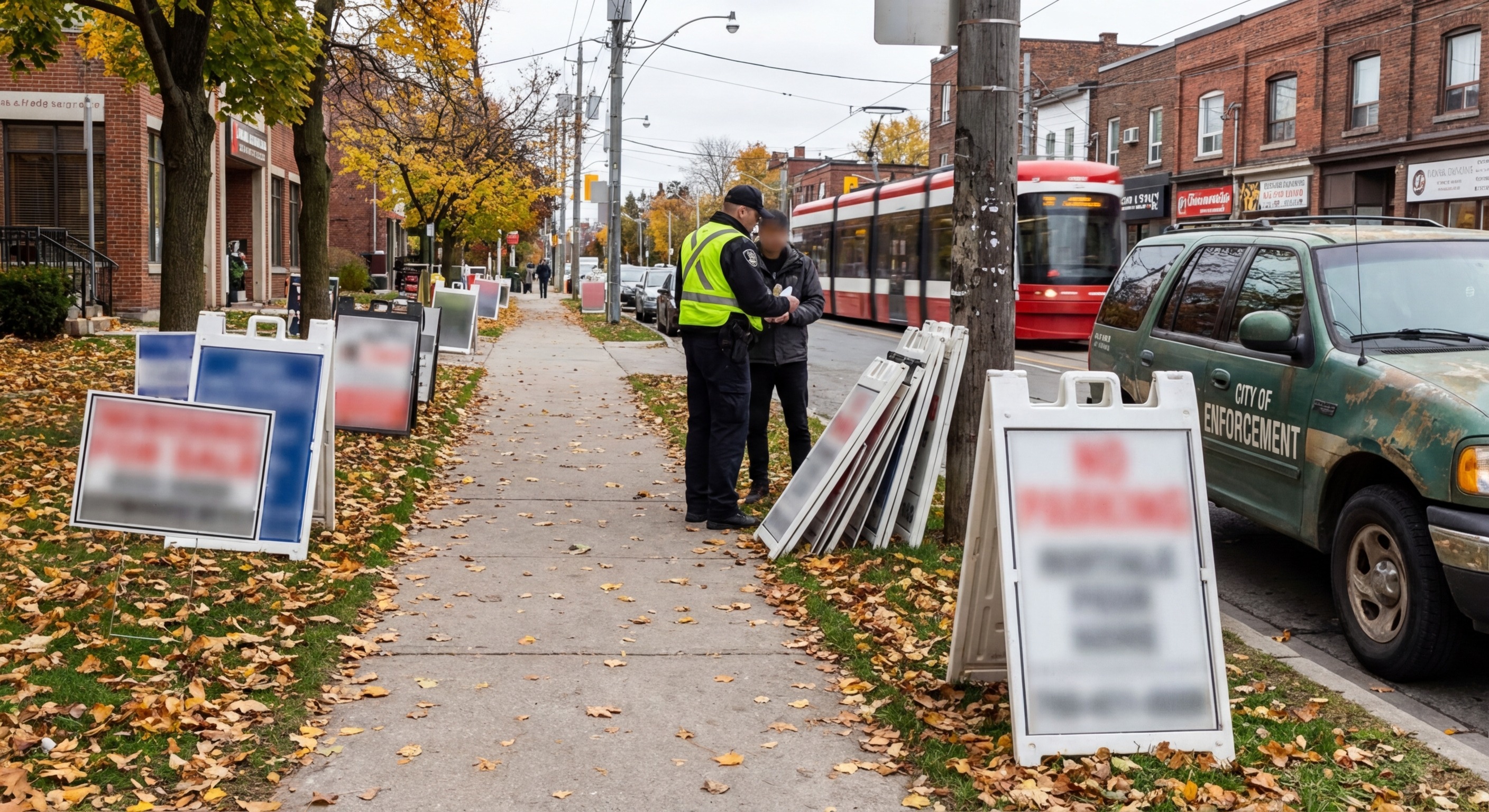
Portable signs generate more bylaw complaints than any other sign type in Ontario. They are also the sign type most likely to be in violation, because the rules are specific, they vary between municipalities, and compliance is low. A business owner who buys an A-frame from a sign supply company and puts it on the sidewalk has probably violated at least one provision of their municipal sign bylaw without knowing it.
The term "portable sign" is a catch-all that covers A-frames (sandwich boards), mobile signs on trailers, temporary freestanding signs, and any other sign not permanently attached to a building or installed in the ground. Some municipalities use different terminology — Mississauga distinguishes between "portable signs" (trailer-mounted) and "sidewalk signs" (A-frames) — but the regulatory approach is similar across the province.
Typical Regulations
While the details vary by municipality, most Ontario portable sign bylaws address:
Size limits. Maximum dimensions for portable signs are commonly 2.4m height and 1.2m width, with a maximum sign face area of about 3 square metres. A-frames are typically limited to smaller dimensions — 0.6m wide by 1.0m tall is a common maximum. These limits are strictly enforced because oversized portable signs are easy to measure and easy to document.
Permit requirements. Many municipalities require a permit for portable signs, even temporary ones. The permit ensures the sign meets size requirements, is placed in a permitted location, and does not create a safety hazard. Permit fees for portable signs are typically $50 to $150, and the permit is valid for 30, 60, or 90 days depending on the municipality. When the permit expires, the sign must come down until a renewal is obtained.
Number per property. Most bylaws limit the number of portable signs per property or per business to one. Some allow two if the property has frontage on two streets. A business that puts out three A-frames along its frontage is likely in violation even if each individual sign meets size requirements.
Placement. The sign must be on private property, not in the public right-of-way. It must not obstruct pedestrian access — sidewalks must maintain a clear path of at least 1.5 to 2.0 metres for pedestrian and wheelchair access. It must not be in a sight triangle at any intersection. In practice, placement violations are the most common problem because businesses put signs as close to the road as possible for visibility, which usually means the right-of-way.
Condition and anchoring. Signs must be weighted or anchored to prevent them from blowing over in wind. An unsecured A-frame that blows into a pedestrian or onto a road is a liability hazard. Some bylaws require signs to be brought inside at night or during high winds.
How Different Cities Handle Portable Signs
Toronto (Chapter 693): Portable signs are heavily regulated. The city has specific provisions for different commercial areas. The BIA (Business Improvement Area) zones sometimes have additional local rules about A-frame placement, materials, and aesthetics. Toronto's enforcement of portable signs is more active than most municipalities because the Sign Unit conducts periodic sweeps of commercial corridors.
Ottawa (By-law 2016-326): Requires permits for portable signs on private property. A-frames on sidewalks are regulated through the Encroachment By-law and require separate authorization from the city. The ByWard Market area has specific rules about sandwich board placement that are more permissive than the rest of the city because foot traffic and street-level advertising are integral to the market's character.
Petawawa (By-Law 1573/23): The 2023 bylaw update tightened portable sign rules after years of complaints about sign clutter along Petawawa Boulevard. The new rules reduced the maximum size, added permit requirements, and limited the number of portable signs per property. Local businesses pushed back, arguing the rules were too restrictive for a community where portable signs are a primary advertising method. The Petawawa case study covers the politics behind the changes.
Mississauga (By-law 0054-2002): Has effectively banned mobile trailer-mounted signs from most commercial areas while allowing A-frames under strict conditions. This reflects a trend in GTA municipalities toward restricting the most visually obtrusive portable sign types while accommodating smaller, pedestrian-scale options.
Why Compliance Is So Low
Several factors drive the high rate of portable sign violations:
- Ignorance of the rules. Many small business owners simply do not know that their portable sign needs a permit, has size limits, or must be on private property. They buy a sign, put it out, and assume they are fine. Nobody tells them otherwise until a complaint is filed.
- Peer pressure. When every other business on the strip has an A-frame out, a new business follows suit regardless of the rules. If enforcement is complaint-driven and nobody complains, the informal norm overrides the formal bylaw.
- Cost-benefit calculation. For a business spending $30 on an A-frame, the occasional $200 fine (if it comes at all) is a reasonable advertising cost. The sign generates more business than the fine costs. This is particularly true for businesses in high-traffic areas where even one additional customer per day justifies the risk.
- Inconsistent enforcement. When a business sees its competitors operating with non-compliant signs for months without consequence, it concludes — reasonably — that the rules are not being enforced. Complaint-driven enforcement means the sign stays up until someone reports it, which can be never.