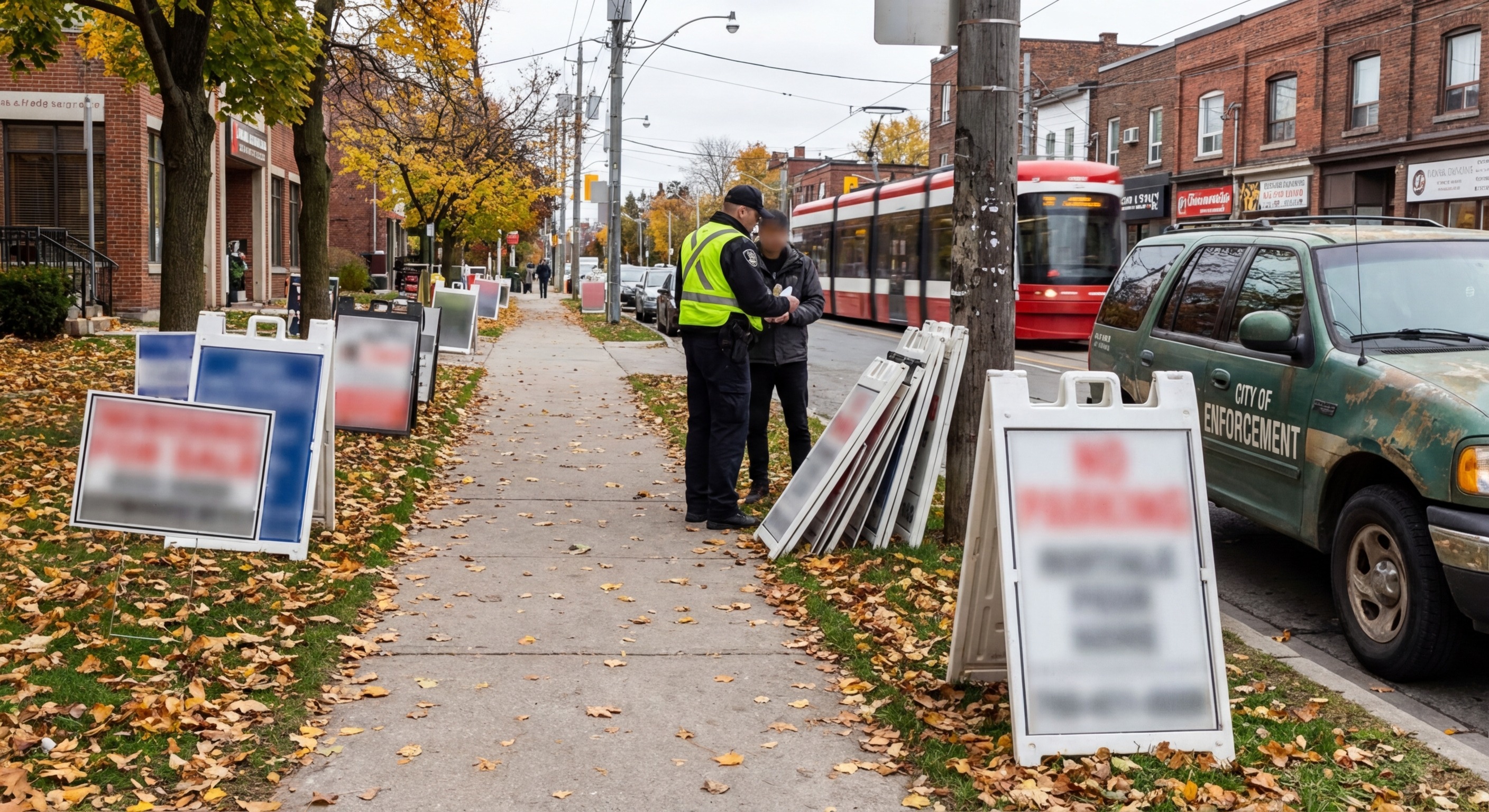
Of all the sign violations that generate complaints in Ontario, signs on boulevards might seem like the most trivial. A real estate sign stuck in the grass between the sidewalk and the road. A restaurant A-frame near the curb. A directional sign for a community event at a nearby intersection. These signs are small, temporary, and seemingly harmless. So why do municipalities care?
The answer involves liability law, intersection safety data, maintenance operations, and the principle that once you allow some signs on public property, you cannot effectively prohibit any. Each of these reasons has practical weight, and together they explain why boulevard sign enforcement persists even when individual violations look minor.
Liability Exposure
The boulevard is municipal property. The municipality is responsible for maintaining it in a reasonably safe condition. When a sign placed on the boulevard causes injury — a pedestrian trips over an A-frame, a cyclist swerves to avoid a sandwich board, a child runs into a sign stake — the municipality can be liable because the obstruction is on its property.
Municipal liability insurers are aware of this risk and flag it. Ontario municipalities have paid claims arising from obstructions on boulevards, including signs. The claims are not always large individually, but they are frequent enough that municipal risk managers include boulevard maintenance — including sign removal — in their liability management strategies.
The Occupiers' Liability Act (R.S.O. 1990, c. O.2) creates a duty of care for occupiers of property, which includes municipalities for public property. A municipality that knows signs are routinely placed on its boulevards and does nothing about it may have a harder time defending a liability claim than one that has a documented enforcement program.
Sight Triangle Safety
The sight triangle is the area at an intersection where a driver's view of approaching traffic and pedestrians must remain unobstructed. Ontario municipal bylaws define sight triangles with specific dimensions — typically 6 metres along each leg of the intersection — and prohibit all signs within this area above approximately 0.75 metres in height.
Signs in sight triangles are a genuine safety hazard. A sign that blocks a driver's view of a pedestrian stepping into a crosswalk, or of a vehicle approaching from a side street, can contribute to a collision. The MTO's collision data for Ontario intersections shows that obstructed sight lines are a contributing factor in a meaningful percentage of urban intersection collisions.
Boulevard signs are particularly problematic for sight triangles because they are often placed at intersections for maximum visibility — the same locations where they create the greatest safety risk. A real estate directional sign or a portable business sign placed at a busy intersection corner may be exactly where the sight triangle restriction applies.
Maintenance Operations
Municipal crews maintain boulevards year-round: mowing grass in summer, clearing snow in winter, repairing utilities, maintaining drainage. Signs on boulevards obstruct these operations.
A snow plow that strikes a portable sign can damage both the sign and the plow. A mowing crew that has to maneuver around multiple signs takes longer to complete the route. A utility crew digging to repair a water line has to move signs out of the way. These are not catastrophic problems individually, but multiplied across an entire municipality over a full year, they represent real operational costs.
Some municipalities have quantified these costs to justify boulevard sign enforcement. The calculation is straightforward: the crew time spent dealing with boulevard signs has a dollar value, and that value exceeds the cost of a targeted removal program.
The Precedent Problem
Perhaps the most important reason municipalities enforce against boulevard signs is precedent. If the municipality allows real estate signs on the boulevard, it cannot reasonably prohibit business signs on the boulevard. If it allows business signs, it cannot prohibit political signs. If it allows small signs, where does it draw the line on size?
The legal principle of consistent enforcement means municipalities risk selective enforcement challenges if they allow some signs on boulevards while prohibiting others. The simplest approach — and the one almost every Ontario municipality takes — is to prohibit all signs on the boulevard and enforce that prohibition across the board.
This creates frustration for people who place well-intentioned signs (community events, garage sales, neighbourhood watch) and see them treated the same as commercial bandit signs. The legal and practical rationale for the blanket prohibition is sound, but it does mean that a church bake sale sign and a "We Buy Houses" sign are both illegal when placed on the boulevard.
Enforcement Approaches
Municipalities use several approaches to boulevard sign enforcement:
- Regular removal sweeps — Scheduled removal operations along major corridors, particularly targeting bandit signs and portable signs in the right-of-way
- Complaint-driven response — Removing specific signs reported by residents through 311 or other channels
- Seasonal enforcement — Increased enforcement during peak sign seasons (spring real estate, summer events, fall elections)
- Education — Some municipalities proactively communicate right-of-way boundaries to real estate agents, BIAs, and community groups
The effectiveness of boulevard sign enforcement depends on consistency. A municipality that removes signs regularly establishes the expectation that boulevard signs will not be tolerated. A municipality that removes signs sporadically sends the message that the rule is optional.