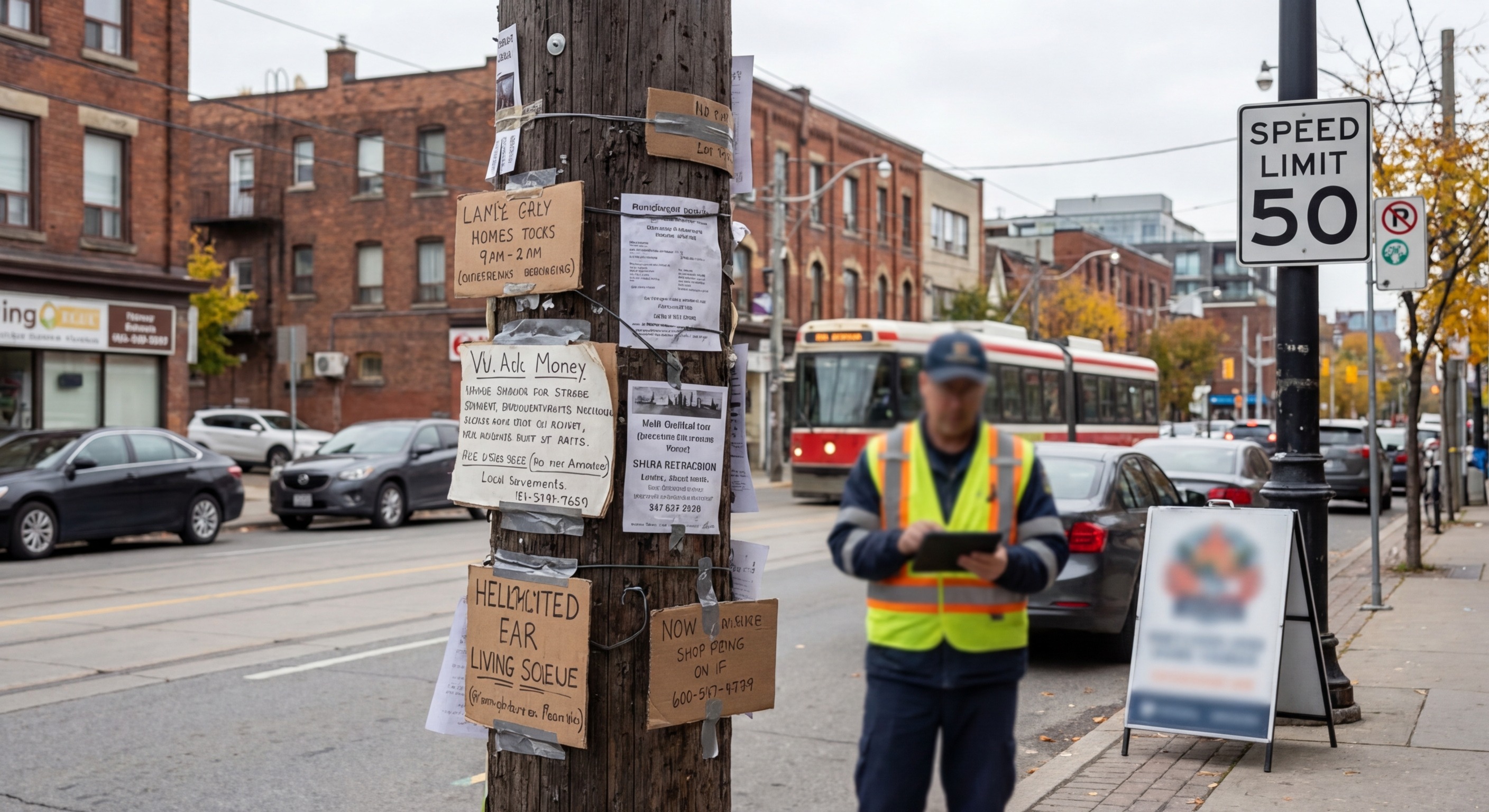
Walk along any busy street in an Ontario city and count the signs on utility poles. "We Buy Houses — Cash." "Junk Removal — Same Day." "Cash for Cars." These are bandit signs — cheap corrugated plastic signs placed illegally on public property, usually overnight, by people who know exactly what they are doing. They are called "bandit" because the placement is covert and the placers are deliberately breaking the law.
Bandit signs are illegal in every Ontario municipality without exception. There is no permit available for placing signs on utility poles. There is no exemption for small signs or temporary signs. The prohibition is absolute. And yet bandit signs are among the most persistent and visible forms of illegal signage in the province, because the economics overwhelmingly favour the sign placer.
The Economics of a $2 Sign
This is the core of the problem. A batch of 100 corrugated plastic bandit signs costs $100 to $200 to produce — roughly $1 to $2 per sign. One person can place 50 to 100 signs in a few hours, working at night when enforcement is off duty. If even one phone call from those 100 signs converts to a customer — a house purchase, a roofing job, a car sale — the revenue can be hundreds or thousands of dollars.
From the sign placer's perspective, the math is simple:
- Cost of 100 signs: $150
- Time to place them: 3 hours
- Expected revenue from one conversion: $500 to $5,000+
- Risk of fine: low (enforcement must identify and locate the sign placer first)
- Likely fine if caught: $200 to $500 for a first offence
Even if 80% of the signs are removed within a week, the remaining 20% may generate enough exposure for the campaign to be profitable. And the sign placer can replace removed signs faster than the municipality can remove them.
What They Look Like
Bandit signs are immediately recognizable. They are typically small (30cm x 45cm or 45cm x 60cm), printed on corrugated plastic, and attached to poles with cable ties, staples, or nails. The most common types in Ontario:
- "We Buy Houses" — Real estate investors seeking distressed properties. Often backed by companies that flip houses or run rent-to-own operations.
- "Cash for Cars" / "We Buy Junk Cars" — Used vehicle buyers.
- Roofing, paving, and renovation services — Often unlicensed or under-licensed contractors.
- Moving and junk removal — Low-barrier-to-entry service businesses.
- Cash loans and tax preparation — Financial services targeting low-income areas.
Paper posters — flyers wheat-pasted or taped to utility poles, newspaper boxes, and walls — are a related category. Community event posters, band flyers, and activist stickers all fall under the same prohibition when placed on public property, though enforcement tends to focus on commercial bandit signs rather than community notices.
Why They Are Always Illegal
The signs are on public property. Utility poles are owned by electrical utilities (Hydro One, Toronto Hydro, Alectra) and located within the municipal right-of-way. No one has the right to attach anything to them without authorization, and authorization is never granted for commercial advertising.
They damage infrastructure. Nails and staples weaken wooden poles over time. Utility workers who climb poles for maintenance can be injured by embedded metal. Cable ties can interfere with utility lines. Municipalities and utilities bear the cost of this damage.
They create safety hazards. Signs on poles can obstruct traffic signs and signals. Signs stuck into boulevard grass obstruct sight lines. Paper posters that fall off poles become litter.
No permit exists. Unlike a portable sign or a billboard, there is no permit process that could make a bandit sign legal. The prohibition is absolute.
Phone Number Tracing
The main enforcement strategy is tracing the phone number on the sign. Because every bandit sign includes contact information — that is the whole point — the advertiser can sometimes be identified. Municipalities may:
- Call the number to identify the business
- Cross-reference with business directories, websites, and previous enforcement files
- Issue a warning letter or compliance notice
- Lay charges under the Provincial Offences Act for repeat offenders
This works when the business is legitimate and traceable — a real roofing company with a business address, an identifiable real estate investor. It does not work when the operator uses a prepaid phone, a numbered company, or an out-of-province address. Many of the most prolific bandit sign operations are structured specifically to avoid identification.
What Municipalities Do
Most municipalities deal with bandit signs through a combination of removal and targeted enforcement:
Removal programs. Regular sign removal sweeps along major corridors. Toronto conducts periodic large-scale removals. Ottawa targets known problem areas. Hamilton focuses on the lower city and mountain access roads. These sweeps remove hundreds of signs at a time, but the signs typically reappear within days.
Targeted enforcement against repeat offenders. Rather than treating each sign as a separate incident, some municipalities build cases against prolific sign placers. By documenting patterns — the same phone number appearing on signs across the city, the same signs reappearing after removal — enforcement can pursue escalating penalties against identified businesses.
Public reporting. Encouraging residents to report bandit signs through 311 services helps municipalities track where signs are appearing and focus removal efforts. Some municipalities have simplified their reporting process specifically for bandit signs.
The honest assessment is that none of these approaches have solved the problem. Bandit signs persist because the economics favour the sign placer, enforcement resources are limited, and the penalties are not severe enough to change the cost-benefit calculation for operators who build sign removal into their advertising budget.